 Wildlife
of Sri Lanka
Spotted Giant Gecko
Geckos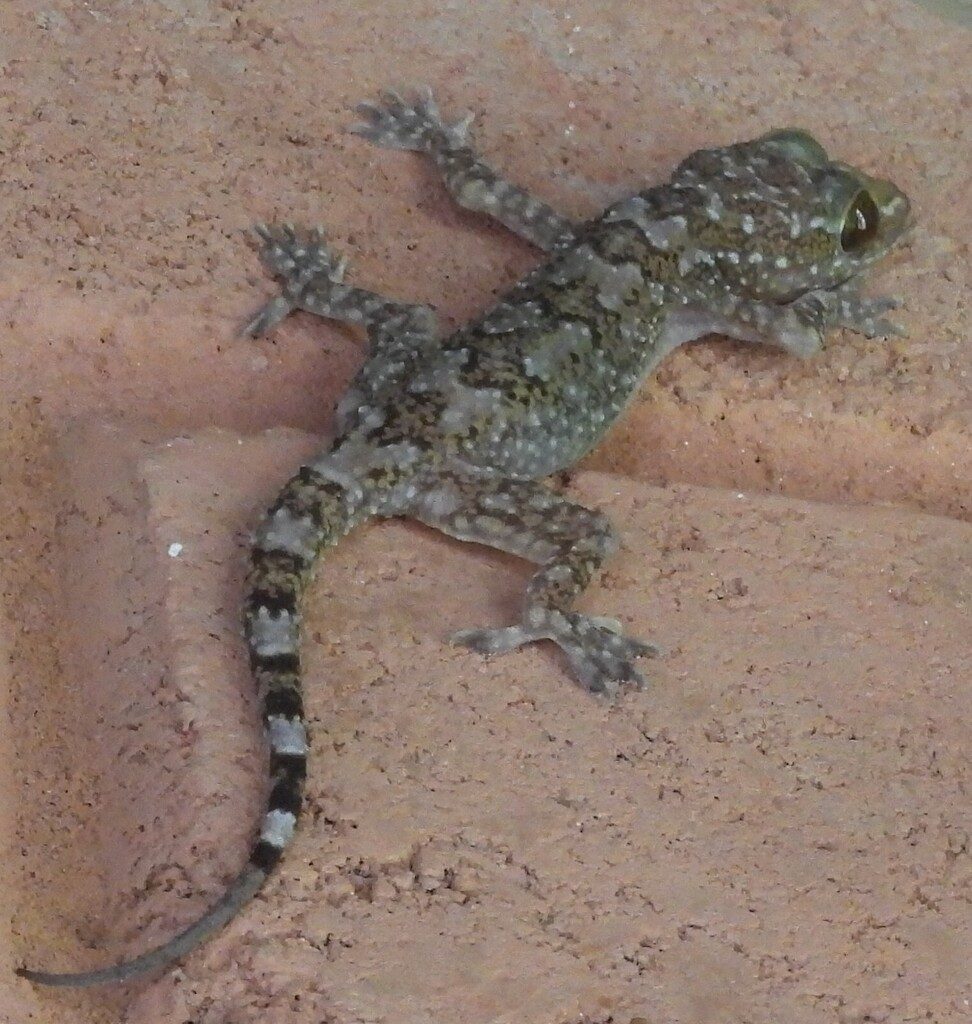
Photo: Sri Srikumar · CC0 1.0
Hemidactylus hunae
Basic stats
Diet
Small insects; other geckos are also taken
Habitat
Rocky outcrops, caves and boulder cracks in the dry and intermediate regions; rarely walls and trees
Range
Endemic to Sri Lanka
Clutch size
2 eggs, March and August
The spotted giant gecko is the largest gecko found in Sri Lanka and is endemic to the island, in the dry and intermediate regions at localities including Nilgala, Okanda, Panamure and Rambukkana. The snout is somewhat pointed, the back has 15 to 20 rows of tubercles, and the ventral scales are smooth. It is greyish brown above with black blotches that expand into rhomboid marks, two dark streaks along the eyes, and a plain creamy belly (Wikipedia, general species account).
It lives on rocky outcrops, in caves and boulder cracks, and more rarely on walls of buildings and trees. Where it shares caves with the golden gecko it is more active at dusk, while the golden gecko is largely diurnal. Females lay two eggs of about 10 by 12 mm in March and August. Nationally Endangered (Sri Lanka National Red List 2012).
Quick answers
- What does the Spotted Giant Gecko eat?
- Small insects; other geckos are also taken
- What habitat does the Spotted Giant Gecko live in?
- Rocky outcrops, caves and boulder cracks in the dry and intermediate regions; rarely walls and trees
- Where is the Spotted Giant Gecko found?
- Endemic to Sri Lanka
- How many eggs does the Spotted Giant Gecko lay?
- 2 eggs, March and August