 Wildlife
of Sri Lanka
Black-cheek Lizard
Agamids & Horned Lizards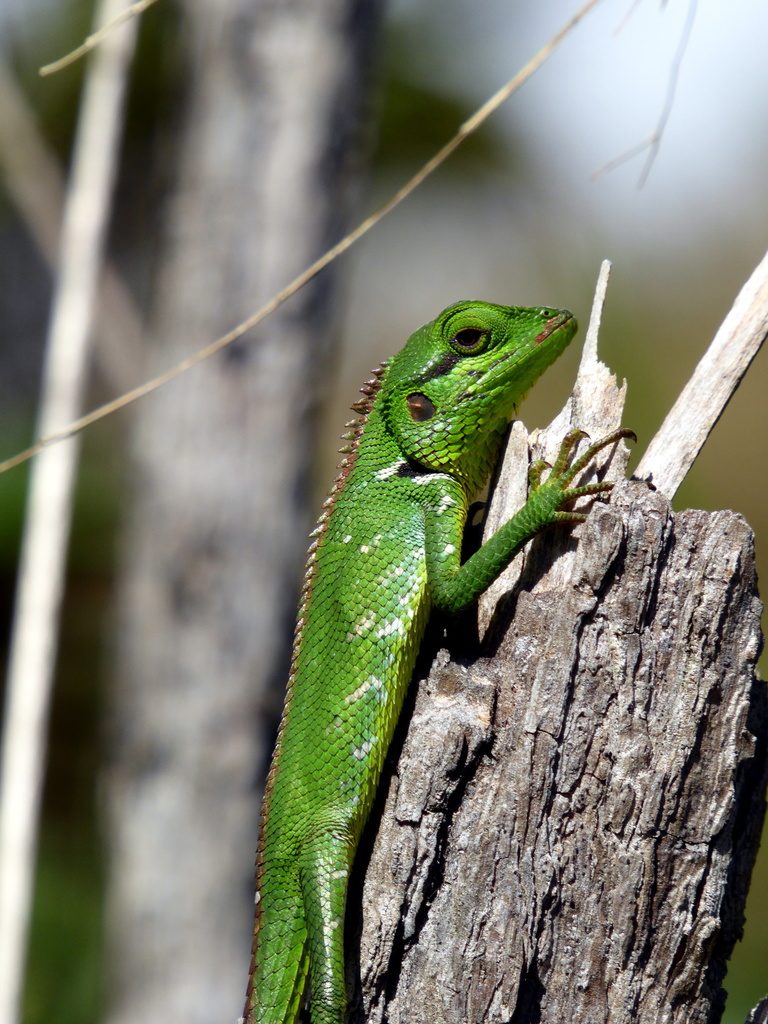
Photo: Kai Squires · CC BY 4.0 (May be cropped or resized)
Calotes nigrilabris
Basic stats
Diet
Insects (bees at Horton Plains) and worms
Habitat
Submontane and montane areas, above about 1,000m
Range
Endemic to Sri Lanka
Clutch size
Up to 4 eggs
Incubation period
About 2 months
The black-cheek lizard is an agamid endemic to Sri Lanka, found at about 1,000 m and above and reasonably common around Nuwara Eliya, Pattipola, Ohiya, Horton Plains and the Knuckles. It is told from the painted-lip lizard by a black bar on the mouth rather than a white or orange one. The head is one and a half times as long as wide, with a row of spines above and behind the ear opening and swollen cheeks in adult males. The back is plain green or has cream, black-edged bars or eye-like spots, and the belly is pale green (Wikipedia, general species account).
It is largely arboreal, on tree trunks, hedges and shrubs, hunting insects and worms by day. At Horton Plains it lives on gorse and rhododendron and hunts bees drawn to the flowers. Females lay up to four eggs in two seasons, November to December and February to March, and hatch after roughly two months. Nationally Endangered (Sri Lanka National Red List 2012).
Quick answers
- What does the Black-cheek Lizard eat?
- Insects (bees at Horton Plains) and worms
- What habitat does the Black-cheek Lizard live in?
- Submontane and montane areas, above about 1,000m
- Where is the Black-cheek Lizard found?
- Endemic to Sri Lanka
- How many eggs does the Black-cheek Lizard lay?
- Up to 4 eggs
- How long are the eggs of the Black-cheek Lizard incubated?
- About 2 months